 Technology
How Internet of Things (IoT) Managed Helps Prevent Data Breaches and Cyber Attacks
Introduction
The Internet of Things (IoT) has revolutionized how businesses operate, offering unprecedented connectivity and data insights. From smart thermostats and security cameras to industrial sensors and connected medical devices, IoT endpoints have permeated every sector. However, with this proliferation comes heightened security risks: unsecured devices can become gateways for cyber attackers, enabling data breaches, ransomware, and large-scale network infiltrations. To safeguard against these threats, organizations are increasingly turning to IoT managed services and platforms – specialized solutions designed to monitor, secure, and maintain IoT infrastructures.
Definition
Internet of Things (IoT) Managed refers to the comprehensive service and infrastructure that oversees the deployment, monitoring, security, and maintenance of connected IoT devices and networks. It ensures seamless operation, data management, and device performance, often provided by specialized platforms or third-party providers to optimize efficiency, scalability, and security in IoT ecosystems.
Understanding IoT Security Risks
Unlike traditional IT assets, IoT devices are often resource-constrained, lacking the computational power to run robust security software. Many devices ship with default credentials, open ports, and outdated firmware – vulnerabilities that cyber criminals readily exploit. Key risks include:
- Unauthorized Access: Attackers can easily scan networks for IoT devices with default passwords, gaining control of cameras, locks, or industrial controllers.
- Data Interception: Unencrypted communications between devices and cloud platforms enable man-in-the-middle attacks, exposing sensitive information.
- Botnet Recruitment: Compromised IoT devices can be conscripted into botnets (e.g., Mirai), amplifying distributed denial-of-service (DDoS) attacks.
- Lateral Movement: Once inside a network, hackers can pivot from IoT endpoints to core systems – databases, user credentials, or financial applications.
Given these threats, manual, ad-hoc device management is no longer sufficient. Organizations require holistic, automated solutions to continually defend, detect, and respond to IoT-related attacks.
The Role of IoT Managed Services
IoT managed services provide end-to-end oversight of device security, from provisioning to decommissioning. Key offerings include:
Automated Device Onboarding and Configuration:
Managed platforms streamline the process of registering new devices, enforcing strong, unique credentials, disabling unnecessary services, and applying security baselines from the outset. The human mistake that comes with manual setup is eliminated with this “secure by design” method.
Continuous Monitoring and Analytics:
Real-time monitoring of device behavior and network traffic helps detect anomalies indicative of compromise – unusual data transfers, unexpected firmware changes, or repeated authentication failures. Advanced analytics leverage machine learning to distinguish benign anomalies (e.g., a scheduled firmware update) from malicious activity.
Centralized Patch and Firmware Management:
Unpatched vulnerabilities are a primary attack vector. Managed services automate firmware updates across large fleets of devices, ensuring that security patches are applied promptly and uniformly, reducing the window of exposure.
Secure Communication Channels:
Data in transit is protected via end-to-end encryption between devices, edge gateways, and backend servers. Managed platforms often integrate certificate-based authentication and secure tunneling (e.g., TLS/SSL, VPNs) to thwart eavesdropping and tampering.
Access Control and Identity Management:
Role-based access controls (RBAC) limit who can view or manage IoT devices. Integration with enterprise identity providers (e.g., LDAP, Active Directory) centralizes authentication and implements multi-factor authentication (MFA) for administrative tasks.
Incident Response and Forensics:
In the event of a breach, managed services offer playbooks and automated workflows to isolate affected devices, collect forensic data, and remediate vulnerabilities. Rapid response minimizes downtime and data loss.
Key Security Measures in IoT Management
An effective IoT management strategy incorporates the following technical and organizational controls:
Network Segmentation:
Separating IoT devices onto dedicated subnets or VLANs prevents an attack on one device from spreading to critical systems. Firewalls and micro-segmentation further restrict communication paths based on device roles.
Zero Trust Architecture:
Zero Trust assumes no implicit trust, even for devices inside the perimeter. Every access request – from devices, users, or applications – is authenticated, authorized, and encrypted. IoT management platforms enforce Zero Trust by continuously validating device identities and behaviors.
Behavioral Baseline Profiling:
By automatically learning normal device behavior over time – typical traffic patterns, connection times, and data volumes – management systems can flag deviations that may signal malware infections, lateral movement, or data exfiltration.
Secure Boot and Hardware Roots of Trust:
Ensuring that devices boot only trusted, signed firmware prevents low-level attacks. Many modern IoT modules incorporate hardware security modules (HSMs) or Trusted Platform Modules (TPMs) to anchor cryptographic keys and verify firmware integrity.
Encryption at Rest and In Transit:
Data stored on devices or gateways – log files, cached sensor data, configuration backups—must be encrypted using industry-standard algorithms (e.g., AES-256). All communications should use TLS v1.2+ or equivalent.
Regular Security Audits and Compliance Checks:
Managed services often include vulnerability scanning, penetration testing, and compliance reporting (e.g., GDPR, HIPAA, PCI DSS). Automated audits identify misconfigurations and non-compliant devices, generating actionable remediation tickets.
Case Studies: Real-World Impact
Manufacturing Plant Deployment
A global manufacturer faced repeated ransomware attempts targeting unpatched assembly-line controllers. After implementing an IoT management platform, the company automated firmware updates and micro-segmented its network. Within three months, cybersecurity incidents dropped by 80%, and unauthorized device logons fell to zero.
Smart Healthcare Facility
A hospital network struggled with unauthorized access to connected infusion pumps and patient monitors. By adopting managed IoT security services—featuring device identity certificates, encrypted tunnels, and behavior analytics – the hospital prevented a serious breach that could have compromised patient data and safety.
Retail Chain Edge Devices
The smart point-of-sale terminals of a national store were the target of skimming assaults. Utilizing managed services, the retailer enforced secure boot, centralized key management, and continuous monitoring, thwarting attempted intrusions and protecting customer payment information.
These examples illustrate that proactive IoT management not only mitigates risk but also builds trust with stakeholders—customers, regulators, and partners.
Best Practices for Implementing IoT Management
Start with an Inventory: Conduct a comprehensive audit of all IoT devices, including shadow and legacy devices. Understanding what’s connected is the first step to securing it.
Define Security Policies: Establish clear baselines for device configuration, encryption standards, patching cadence, and access controls. Policies should align with industry standards and compliance requirements.
Choose the Right Platform: Evaluate managed services based on scalability, ease of integration (APIs, SDKs), vendor neutrality, and the breadth of security features (analytics, incident response, compliance).
Integrate with IT and OT Teams: Close the gap between IT security teams and operational technology (OT). Joint governance ensures consistent policies across industrial and enterprise networks.
Train Staff and Stakeholders: Security is not purely technical. Provide ongoing training for administrators, engineers, and end users on secure device handling, password hygiene, and incident reporting procedures.
Monitor and Iterate: Security is a continuous endeavour. Regularly review dashboards, audit logs, and alert metrics. Refine detection rules, update policies, and conduct tabletop exercises to test response readiness.
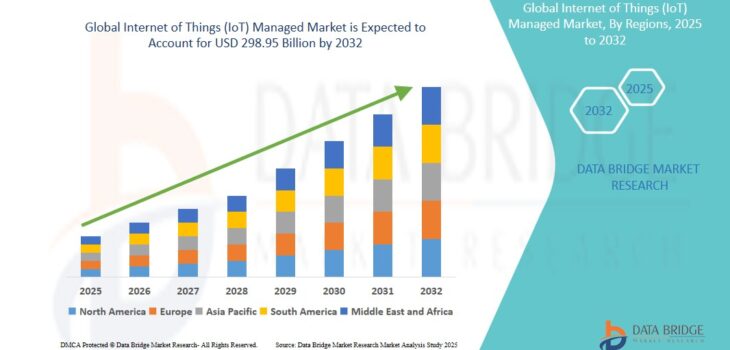
Expansion Rate of Internet of Things (IoT) Managed Market
According to Data Bridge Market Research, at a compound annual growth rate (CAGR) of 16.5%, the worldwide Internet of Things (IoT) managed market is expected to reach USD 298.95 billion by 2032, from an estimated USD 88.62 billion in 2024.
For more insights on the autoimmune disease treatment Market visit:
https://www.databridgemarketresearch.com/reports/global-internet-of-things-iot-managed-market
Conclusion
As the IoT ecosystem continues to expand, the attack surface for cyber criminals grows in parallel. Unmanaged or poorly secured devices can serve as beachheads into sensitive networks, leading to data breaches, operational disruptions, and reputational damage. By leveraging IoT managed services, organizations gain automated device onboarding, continuous monitoring, patch orchestration, and incident response capabilities—all under a unified, scalable framework. Implementing robust security measures such as network segmentation, Zero Trust, and behavioral analytics further fortifies the environment.